Stupidity is the new uh, stupidity

A little while ago, I related a charming and heartwarming story of willful and persistant stupidity in the face of the concerted efforts of cluefull to avert disaster. Sadly, I must inform you all that - at least in this instance - evil and the forces of dimness have tirumphed.

My acquaintances inform me that after a meeting involving high level and well paid representatives of their client, as well as their own CIO, it was decided to implement option "a" of the two methods I described in my earlier post. Now these proud and competent programmers have to write code that will propagate this retarded and blinkered parody of good accounting practice. When it comes to bad accounting, at least the Enron people were clever and stole money. These idiots should by rights be toothless and banjo-picking somewhere decent people are afraid to go.

Posted by Buckethead Buckethead on   |   § 0

I Now Pronounce You Goodwyfe and Goodwyfe

Working my way through Francis J. Bremer's John Winthrop: America's Forgotten Founding Father, I come by this tidbit:"[in the Massachusetts Bay colony,] [m]arriage was rejected as a sacrament and became a civil ceremony performed by local magistrates."

Fascinating. The effect of reading books like Bremer's is always to remind the reader that the history of religion is far less monolithic than one assumes at first glance. We talk about "The Puritans" and "Puritanical Morals" without understanding, or at least acknowledging, that there was no such single thing as "Puritianism." The congregations of Stour were not the congregations of Ely were not the congregations of Delft were not the congregations of Salem. Each group, indeed each Puritan, carried with them their own particular ideas of gospel. Though they agreed on major principals (e.g. predestination, the perfidy of Rome and ceremony, the depravity of the Arminian and Antinomian heresies, the primacy of scripture and the duty of good Christians to be living examples for the unconverted), they disagreed on a million minor points. They were protestants, after all!

I always have to chuckle at modern churches or religious groups who lay claim to the heritage of the Puritans. When you look closely you find funny things that subvert that aim. For example, the fact that opponents of gay marriage who object on religious grounds to that innovation frequently point to the unbroken primacy of Christian marriage under the auspices of church in Western society, (Christian nation, founded by Christians, God God God all the time forever amen etc. etc.) but in Massachusetts - the first and most serious religous experiment attempted by colonists on these shores - marriage was by law a civil ceremony divorced from the church even in 1630, a time when the Massachusetts Bay Colony was 100% Christian crusaders aiming to be a beacon of Godliness to the world and shunning from society those who fell short.

Which, by the way, I never would have suspected.

[wik] I would point out by the way to smarty pantses who would argue that civil society = religious society in the MBC that that simply wasn't true. Church leaders who became civil leaders were asked to resign one or the other posts.

[alsø wik] Am I the master of the run-on sentence with nested dependent clauses, or what? I frigging rule!!!

Posted by Johno Johno on   |   § 2

Research Promises More Fulfilling Robotic Relationships

British researchers, long at the forefront of bringing humanity new knowledge with practical applications, has wowed the planet with this revelation:

Wining and dining is the best way for men to woo women

Holy fuck! If you spend time with women and give them things, they tend to like you!

Apparently the Brits designed,

a mathematical formula and modeled courtship as a sequential game to find the best way to impress the ladies.

I applaud science's efforts to quantify attraction. Beyond the obvious relationship of quantity of dough being proportional to the raw attractiveness of the dough-holder. I get that. But spending alot of time and effort to determine the patently obvious, for its own sake, makes me want to eat my own shoe in sheer frustration.

After a stiff drink and a percodan, and with a little reflection, I realized a greater shortcoming here. What the study fails to take into account is that different cultures value different gifts, particularly in the awkward cultural judo that courtship can be. The study really only applies to places where wining and dining is an accepted, or indeed feasible, practice. Nor does the work draw a distinction between eateries. At Outback, say, dinner for 2 can be kept under $40; a decent steak dinner in, say, Japan can run around $170,000.

But why have to deal with exchange rates and kooky foreign currency and decent meats at all if you don't have to? Leave it to the Japanese to build their own dates.

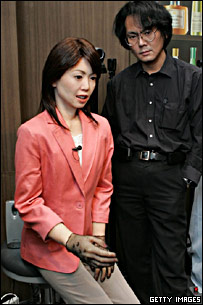
Professor Hiroshi Ishiguro has gone the extra mile in building life-mimicking features into his design:

image

Um, the dude with glasses is *not* the robot.

The robot exhibits several tiny mannerisms that we all share- blinking, laughter- and that we pick up on when others don't do them. It even simulates breathing, which I definitely notice when people I'm speaking to don't do it.

So okay, this cat built hisself a lady. And yes, that's quite cool enough all on its own. But looking forward, it doesn't take a crystal ball to see the most lucrative aspect of this technology. And it ain't mining ore or building cars.

Look, consider a company like Vivid Entertainment. As a private concern it doesn't have to make its financials available, but $100 million in sales is entirely plausible if not conservative. And that's just to look at Jenna Jameson. How much could they make by building a simulacrum that mirrors Jenna's look, physique, and...talents...perfectly? How much is the porn-bot market worth, when DVD and On-demand sales or rentals can run into billions?

Then, consider other ramifications of life-like bots. Would someone be a pedophile if he bought one that looked like a child for sexual purposes? It's not totally off the mark, by the way: the fembot in the pic is that professor's second design. The first one simulated a five-year old girl. What copyright issues would be at work when licensing not merely your likeness, but your simulation? Could you draw a paycheck if you sent your robotic doppleganger to your job to work in your stead? Could I marry one in Massachusetts? If I had sex with one that was a reproduction of myself, would I be a homo, or masturbating? Could you design a robot so advanced it didn't know it was a robot, then make it a cop who assassinated other robots after giving them a weird psych test...?

Or might it be possible to build a 'bot so true to life it would supplant women altogether? And not like a Stepford Wife- I mean, they could talk, after all; speech should be a bug, not a feature- I mean perfect. Arguably, men have been trying to replicate women for quite some time, although the robust materials and scale at play here have been significantly refined of late. Can the perfect woman be built from plastic and silicone?

Don't get too irritated with me, ladies. It's taken menfolk millenia to approximate you, but you've had a reliable and simple substitute for us for eons.

Posted by GeekLethal GeekLethal on   |   § 9

Why can't we all just get along?

Hilary Clinton recently addressed the DLC in Columbus, Ohio (the heart of the heart of it all) calling for party unity in the face of backward time-tunneling Republican trucksuckers. Predictably, a call for party unity resulted in fratricidal infighting. Much like the Scots, the Democratic party is locked in mortal combat with its eternal enemy, the Democratic party.

The infamous McQ, over at Q and O, has a thoughful and, uh, infamous post up on that very topic. After ably and efficiently reviewing the background (go read) he gets to this point:

She walked into an ideological buzzsaw and now is trying to stitch the effort back together. Look, if the Dems are going to have any chance in '08, they are going to have to settle their internal dissonance. They are going to have to come up with a unified strategy and a candidate who is capable of carrying it through. The sort of in-fighting being witnessed now is how it will be done. But based on the reaction to Clinton's speech, she may not be as strong a candidate for that position as many on the left would like to believe.

To be sure, infighting will not help the party gain electoral victory. We saw infighting on the left last time around, and there is no reason to suppose that it will be better next time. But look at what the result of that infighting was: the party nominated a Massachusetts liberal. Sure, they didn't pick Dean, but Dean removed himself from the running with some ill-considered vocal performances. It's as if the Democrats, seeing Bush, thought the Republicans were triple-dog-daring them to prove that, yes, they could pick a worse candidate. The only sensible Democratic candidate was Lieberman. But he was as welcome as a red-headed stepchild. The influence of the DLC and other centrist organizations within the party had never been lower.

Overall, I think McQ's analysis is spot on. But he concludes:

I'll watch with interest how this all lays itself out, but suffice it to say, the more radical left is making its play for the soul of the Democrat party.

And that's where I'd have to disagree.

The left won the soul of the democratic party back in 1972. The DLC and similar efforts have been fighting a rear guard action ever since. They managed to sneak Clinton in, but the left of the left has generally prevailed at all national levels - and the result has been the alienation of the leftish center - the Reagan democrats, the DLC, Blue Dog Democrats or whatever you want to call them.

Both democratic presidents since that date have been anomalies. Carter nearly didn't get elected despite the fact that the incumbent administration was heavily tarred with the watergate scandal. Clinton would never have won without Perot splitting the center/right vote. In neither of his victories did he get a majority of the vote.

An incumbent vice president couldn't quite manage to win, despite the fact that Bush Jr. is arguably one of the weakest candidates the Republicans ever nominated. And they couldn't defeat him the second time, despite the quagmire in Iraq and the Bush's flat-out abysmal job approval ratings.

And, they've progressively (sorry) lost ground in both houses of congress, even in off year elections where the opposition usually gains seats. Even if Hilary wins the nomination singing DLC chops, she won't have a chance unless the world blows up or the Republicans nominate another W. She won't have a sufficiently large base, and she'll have to do too much to appease the left that is the strongest part of her party.

Posted by Buckethead Buckethead on   |   § 13

More gods than you can shake a stick at, plus the stick

Over 2100 gods online! Your online source for divininty of all shapes, sizes, colors, and ethnicities. It's Godchecker.

Merely a taste of the divine tastiness you wil find at godchecker:

FAFNIR: He was the son of HREIDMAR the wizard, together with two brothers, OTR and REGIN. Shape changers all. When OTR was in otter form, LOKI, who fancied a nice bit of otter to go with his fish, killed him by mistake.

Google image search said that this is a picture of Fafnir

This was a big mistake since he turned up at HREIDMAR's house in the company of HONIR and ODIN bearing a strangely familiar otter skin. The wizard family thought LOKI was a rotter. Now LOKI, HONIR and ODIN were in deep trouble.

LOKI, using all his considerable cunning, suggested a hefty ransom fee to repay his debt. This was agreed and the other two Gods were taken hostage until his return. Knowing where ANDVARI the Dwarf King kept his treasure, LOKI forced the dwarf to hand it all over, even down to a special gold ring he'd just forged. ANDVARI just had time to curse the ring so it would bring doom to whoever owned it.

LOKI never got to own it - in fear of his life and those of his compatriots he took it straight to the wizards, who released the Gods after a quick gloat.

FAFNIR gloated the most and was so inflamed with greed he turned himself into a dragon and stole the hoard, hiding it in a mountain lair where he could carry on gloating. He killed his father and exiled his brother REGIN, who by chance ran into the hero SIGURD.

The curse was now working overtime. SIGURD ambushed and killed FAFNIR, taking the treasure and pocketing the ring to use for a planned engagement to BRYNHILD. Untimely ends followed shortly.

Mythology with an edge, the sacred cut with sarcasm. It's crazy, it's wacky, it's Godchecker.

Posted by Buckethead Buckethead on   |   § 5

Where Art and Commerce Meet, There is Greatness

Country music has a problem. As I opined a while ago writing about a career retrospective of songwriter and singer Rodney Crowell, Nashville tends to eat its dead. At the first sign of weakness, great artists with storied careers eventually find themselves unable to get radio play, press attention, or a cup of coffee on the strength of their good name. Within Nashville society, this means that elders are given lip service but shunned in public. In the larger picture, this means that country oldies radio is at best a niche genre, relegated to a late-night set or the far reaches of the AM dial. Instead, most country radio dedicates itself to whatever’s hot on the Country Top 40 chart, wasting good time on fatuous dreck by Toby Keith (he’s a Ford Truck man!) or the animatronic wonder called Shania Twain.

From time to time, country does return to its roots. After the great Countrypolitan revolution of the 1980s came a revival of classic sounds, boosting the careers of Randy Travis and Clint Black among others. Currently artists like Faith Hill and LeAnn Rimes (talented ladies both) have released albums reasserting their down-home credibility, correctly sensing that actual people in Kentucky, Wyoming and even Maine mostly drive pickups and wear blue jeans, not BMWs and Manolo Blahniks.

But this unfortunately does not mean an actual rediscovery of the past. There are literally dozens of incredible artists who once had massive careers who now languish in semi-obscurity. The living at least have a chance at redemption through a comeback record. The departed are not so lucky, and it falls to dedicated cadres of fans at record labels, radio stations, and in the record-buying public to keep their flame alive.

In a fortunate confluence of purpose and commerce, Sony has been compiling excellent best-ofs from their catalog under the “Legacy Essential” series for several years now. Already country greats like Johnny Cash, Kris Kristofferson, Willie Nelson, and Earl Scruggs have gotten their due, and now Legacy have added the great, half-forgotten Marty Robbins to this list.

Casual music fans might be forgiven for thinking Marty Robbins was a one hit wonder. Everybody knows “El Paso,” one of the biggest hits in the history of country music and one of the catchiest tunes ever written. The opening line “Down in the old Texas town of El Paso, I fell in love with a Mexican girl” is probably better known to most people than “We the People of the United States, in Order to form a more perfect Union....”

In truth, “El Paso” is only one hit among dozens more. Robbins spent the mid-1950s through the early 1980s in the country and pop charts, logging 81 country Top 40 hits, 31 pop crossover hits, and spending a collective 63 weeks at #1. That’s a run not unlike Sir Elton John’s, who nevertheless remains a household name while even casual country fans need to struggle to remember the name of... ohh... you know that one guy? Who did that song? You know, “Down in the old Texas town of El Paso?”

Moreover, just as Robbins was not only a country star, he was not merely a country singer. Indeed, the two disc The Essential Marty Robbins makes a case for Marty Robbins as the country-flavored counterpart to chameleonic phenomenon Bobby Darin. Like Darin, Robbins is remembered for a major novelty hit or two (“Mack The Knife,” “El Paso”) and a rock and roll hit or two (“Splish Splash,” “White Sport Coat (and a Pink Carnation).” Like Darin, Robbins worked in many styles throughout his career, defying easy pigeonholing. And like Darin, Marty Robbins was not blessed with a perfect voice. Not as rich as Elvis,’ not as resonant as Cash’s, and not as emotive as George Jones, his slightly brittle tenor nevertheless featured an affecting quaver and technical ability that made up for any shortcomings, and he turned in outstanding vocal performances in a wide variety of genres.

Also like Darin, Robbins’ legacy is a victim of his biggest hit. Although the chronological running order on Essential shows that Robbins excelled in many genres (rock and roll in several styles, Western swing, country, blues, countrypolitan, and straight pop) throughout his career, and although he wrote his own material, it is still necessary to for the compilation to prove that there was more to him than just one long story song set in New Mexico.

Discovered by Don Law and signed to Columbia in 1952, Robbins’ first hits were in the country style of the day, featuring acoustic and steel guitar and melodies reminiscent of Hank Williams. One of his early hits was an Elvis-like cover of Arthur Crudup’s “That’s All Right Mama,” suggesting that he had not quite yet figured out who he was going to be.

By 1957, however, the answer seemed clear: Mary Robbins was going to be everybody. In 1957 and 1958, he charted two doo-wop teen-love pop ballads (“A White Sport Coat (and a Pink Carnation),” “She Was Only Seventeen (And He Was One Year More")), two country/rockabilly tunes (“Just Married,” “Ain’t I the Lucky One,”), a poppy tune reminiscent of “Mr. Sandman, Send Me a Dream” ("Stairway of Love"), a country blues (“Knee Deep in the Blues”), and the Hawaiian-tinged “Story of My Life.”

In 1959, Robbins was astute enough to pick up on Johnny Cash’s success singing cowboy songs, and began turning out western swing and Mexican-flavored tunes. The most famous of these was of course “El Paso,” one of the biggest hits of the year, but there was also “Ballad of the Alamo,” “Big Iron,” “Devil Woman,” and several others.

He would continue to have success in the western style throughout the 1960s, charting with songs like “The Cowboy in the Continental Suit,” and “Tonight Carmen,” all the while also turning out straight country hits like "The Shoe Goes on the Other Foot Tonight."

The 1970s and 1980s blunted Robbins’ attack in the way it did so many others - by drowning his songs in an ocean of strings. His go-to producer in the late ‘70s and early ‘80s was Billy Shirell, known for his devotion to overproducing every song to the point of parody, and – yep – strong songs like “Among My Souvenirs” "Some Memories Just Won't Die" are nearly unlistenable under the thick film of keyboards, strings, choirs, and noise-gated drums, forcing Robbins to belt like Jim Nabors to be heard over the din. Many songs from this era seem more suited to the tacky spectacle of Elvis’ Vegas showroom than to Robbins’ simple delivery.

The final song on Essentials is “Honkytonk Man,” the title song from the 1982 Clint Eastwood film of the same name. Though near death from chronic heart disease and nearly overpowered by the overproduction, Robbins nevertheless gives an affecting and lovely performance. His voice is deeper and rougher, and he seems finally to have discovered how to sing a ballad without crossing into maudlinness. It seems that Robbins died just as he was entering another chapter of his career, one where he finally figured it all out.

But Robbins’ voice wasn’t the main attraction. He was also top notch songwriter, and the diversity of the songs collected here make a strong case that he was one of the very best. He was audacious enough to write “El Paso” after all, which hit #1 on both the country and pop charts in 1959 despite clocking in at nearly 5 minutes long.

But not many people know about the followup song, “Faleena (from El Paso),” an 8-minute LP track from 1966 that tells the story of the ill-fated woman from “El Paso,” including the events from the original song from Feleena’s perspective. The songs together spend thirteen minutes on what is admittedly a maudlin and thin little tale, but Robbins’ songwriting is so strong that the two songs together come across as grandly, epically tragic.

Robbins would even return to this well again in 1972 with the #1 hit “El Paso City,” about a man visiting El Paso and half-remembering how “long ago he heard a song about a Texas Cowboy and a girl” though he “don’t recall who sang the song, as I looked down on the city I remembered each and every word.” That’s three songs drawn, Rashomon-style, from one little story of a love triangle and a gunfight. That’s talent to spare.

While far from comprehensive (more than half of his 81 Top 40 hits are missing) The Essential Marty Robbins is an outstanding introduction to one of the forgotten legends of country music. If ever we needed more proof that country, rock and roll, and pop were for much of the 20th century the same thing, we have it. With country starting once again to rediscover its roots, hopefully Marty Robbins will get the credit he deserves as one of the master songwriters and mainstays of country music for thirty years.

This post also appears at blogcritics.org

Posted by Johno Johno on   |   § 2

UAV Successfully Fires Test Rockets

A couple days ago the RQ-8 Fire Scout fired two Mark 66 unguided rockets, becoming in the process the first autonomous, unmanned helicopter to undergo a successful live weapons fire.

image

Northrop Grumman is developing the Fire Scout for both the Army and Navy. "Today's test is a big step in the development of future UAVs across the entire industry," said Doug Fronius, Northrop Grumman's Fire Scout program director. NG is a big player in the unmanned autonomous vehicle field - uavs in service, production or development include the U.S. Air Force RQ-4 Global Hawk and Army RQ-5 Hunter that are already in service; the BQM-34 and BQM-74 aerial targets; the multi-role Hunter II proposed for the Army's next-generation, extended-range, multi-purpose UAV program; the X-47 Joint Unmanned Combat Air Systems for the Defense Advanced Research Projects Agency, Air Force and Navy; and advanced systems like the KillerBee program being developed for low-altitude, long-endurance missions.

This is the future. Stealth can be defeated. Spoofing and jamming systems can be defeated. Any manned combat vehicle is vulnerable. Given our aversion to avoidable casualties, it will make increasing sense for hazardous missions to be alotted to autonomous combat vehicles. Instead of sending a billion dollar B-1, and risking the lives of its crewmen, send in a a flock of hundred thousand dollar drones armed with bombs and missiles. With satellite links back to controllers sitting in front of a monitor hundreds of miles away, you have greater ability to call the shots and ensure the destruction of the target. Loss of one or two drones doesn't risk mission failure. No possiblility of friendly casualties. The fighter jocks and bomber pilots in all the services will fight this hard, but the logic of redunduncy, accuracy, safety, economy will eventually win no matter what they do.

Posted by Buckethead Buckethead on   |   § 6

When all you have is a thesis,

everything looks like an argument. Which is to say, studying something very very closely will sometimes result in surprising insights. Of course, other times you will come to completely insane conclusions that no sane person would find persuasive; say, the theory that gay people threaten my and your marriage. (Okay, that was a misrepresentation. People who say that have not studied the issue closely at all.)

What is this guy talking about, you ask? First he's on about theses acting like hammes, then something about the gays, and now we're waist-deep in a thicket of self-referential onanism that would redden the face of David Eggers. If I'da wanted this kind of crazy today I'd have called up the Lyndon LaRouche hotline!

Well, here's the thing. NDR, also known as Nathaniel of Rhine River is writing his dissertation on, loosely speaking, issues of identity in the Rhine River region, which is neither specifically French nor German.

He finds some parallels between the American project in Iraq and France's integration of Rhenish peoples into France. To wit: Rhinelanders accepted France for the stability and infrastructure they lent, but still resented them for the supercilious frogs they were, so to speak. And this might be a sign of a healthy people.

Also, one of his bunnies recieved an unintended bris thanks to his other bunny. Weird.

Posted by Johno Johno on   |   § 2

Bridges, horses and frogs; fire trucks and big black trucks

My son is of an age where he is expanding his vocabulary at exponential rates. In his great rush to add new words to his repertoire, he is sometimes slightly less than scrupulous in assuring that his pronunciation of a new word is correct before jumping to the next bright, shiny new nym. In most cases, mispronunciations or misstatements are merely cute. Of course, most anything a two-year-old does short of a full on temper tantrum is cute.

There are exceptions. For example, there is a set of common words that, translated through the mind and underdeveloped vocal apparatus of a small child that come out not just wrong, but wrong. We first noticed this phenomenon when Sir John-the-unintentionally-profane began to utter his charming version of the phrase, “fire truck.” Imagine that the second through sixth letters are not there, and you’ll have a solid idea of what came out of my son’s mouth.

At first, this was amusing. It was amusing because I have a dirty mind and we were not in the presence of strangers. As soon as he shouted his adorable riff on “fire truck” in public, I was mortified. After a kindly grandmotheresque woman at the grocery store informed me that this is, in fact, a common occurrence, I felt better. I went straight back to amused, though I attempted to act unamused so as not to encourage potty-mouth.

John got a little better at saying fire truck, though when under stress or excitement he would revert to his original model. Things seemed to be getting better. Then, on the way home from Ohio, he sort of learned to word, “Bridge.” There are quite a lot of overpasses on the interstates. For hours, my wife and I were treated to the spectacle of a cute, high pitched voice saying, “Under bitch?” about once every twenty minutes.

Over the next few days, I waited, hoping for that magical moment when I would see a fire truck on a bridge. My wife was not amused when I pointed it out to my son and then nearly drove off the road when he said, “Fuck! Bitch!” A little later, the word frog also transmogrified into ‘fuck,’ increasing the likelihood that we would be embarrassed in public. Whenever John said something that sounded obscene in the presence of others, my wife would be at pains to quickly and loudly say, “I don’t see any frogs, John.”

Shortly thereafter, my wife made the colossal mistake of pointing out that the pickup in front of us was both large and black. This was unfortunate because, a) John loves trucks and won’t stop talking about them and b) he pronounces the word truck more like “cock.” I was laughing, but in a sick and terrified way, as my son kept repeating that phrase. Even more so when he added, philosophically, “I like it.”

A friend, who works at a day care center, told of us of a child there who was normally very quiet and reserved. Unbeknownst to the staff, he harbored a deep and rather possessive love for horses. He did care for other children playing with the horses, nor did he care to pronounce the first ‘s’ in that word. So when some other miscreants started playing with his horses, we waded in, fists flying, crying, “My whores! My Whores!” I didn’t think a two year old could be that advanced on the pimp career track.

Put that kid with mine, and you’ll have a regular def comedy jam, or the vocal track to a decent rap album or porn movie.

So remember, tell all the horses and bridges to shut the frog up, you trucksuckers.

Posted by Buckethead Buckethead on   |   § 4