Who is America's preeminent racist?

According to Silfay Hraka (originators of the Carnival of Vanities and this), it is Jesse Jackson. I'd be hard pressed to find a better candidate. There are more virulent and less pc racists in quantity, but none possess the oily charm, press credibility and ability to rhyme of Jackson. Money Quote:

Of course, U.S. Army Lt. Gen. Russell Honore, head of the military task force overseeing operations in the three states, is black. And competent, Jess, as if that matters to you. But it doesn't, because what Jesse Jackson sees in people begins and ends with the pigment in their skin. He is this nation's most prominent racist.

It's more than that, though. Jesse Jackson is in the racism business. If racism did not exist, Jackson would have to invent it.

Racism most assuredly exists, but not in sufficient quantity to support Jesse's tailored suits and comfortable lifestyle. Thus, he must create racism where none exists. ...

Thanks, Jesse. Thanks for making America just a little bit worse with every word you speak. Racism is your business, and you're making sure business is good.

Jesse Jackson is all about making racism pay - for him. A few threats of publicity, and most large corporations will make large donations to the rainbow coalition fund and set aside some business for Jackson's cronies. I feel for the pain of Jackson's wife, but the period immediately after Jesse's adultery scandal was so relaxing simply because of his embarrassed absence.

Posted by Buckethead Buckethead on   |   § 0

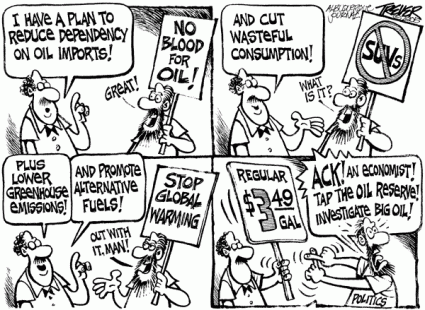
An economist! Shoot!

I can't remember how I ended up there, but I found this amusing cartoon at Russ Nelson's blog:

effing economists with their stupid sensible ideas

(The cartoonist is John Trevor, and he's got other cartoony goodness here.)

Although the cartoon pretty much says it all, that won't stop me from saying more. Market solutions are often invisible, or at least camouflaged. It's not all deregulation and privatization. Since the rise of the computer and internet age, a growing portion of the population (though still small) has come to realize that prices are not just amounts of money, but information.

The reason why price controls and so on don't work is that they are basically lies. Lies on a grand scale. They so distort the information that market prices are trying to transmit to both buyers and sellers that no one can operate normally. Black markets are in one sense back channel efforts to find the truth of what things are worth. Honesty is the best policy.

Posted by Buckethead Buckethead on   |   § 2

A (nearly) Forgotten Anniversary from the Forgotten War

This week marks the 55th anniversary of the amphibious operations at Incheon/Inchon.

Stars and Stripes covered ceremonies held mid-week at the memorial in Incheon. I learned that the monuments and statuary of soldiers at the memorial is a cause of tremendous grief to Korean lefties, which is probably an excellent reason on its own to fight savagely to keep them there. They forget that if not for us, they'd all be speaking Korean now.

The US Navy has alot of cool maps, photos, and detailed exposition discussing the preparation and execution of the attack here.

Here's the short version: The hammer was the attack north out of the beleaguered Pusan Perimeter. The anvil was 70,000 soldiers and Marines put ashore at Incheon. The walnut was the North Korean army in the field.

Posted by GeekLethal GeekLethal on   |   § 9

"What's wrong with stately?"

Ist. Statist. That's different.

Via Hit N Run, the money quote from last night's presidentiary address:

It is now clear that a challenge on this scale requires greater federal authority and a broader role for the armed forces -- the institution of our government most capable of massive logistical operations on a moment's notice.

Riiiiiiight. So, the only two differences between the Republicans and Democrats are now that the Republicans love the military and some Democrats love gays and rain forests? That's it?

Screw it. B, you're old enough... run for President. Your country needs you.

Posted by Johno Johno on   |   § 1

The Iceman and the Spaceman, Together at Last

Who here knows from Johnny "Guitar" Watson?

I bet that right now some tiny renegade soul station in Baltimore, Detroit, D.C. or one of the other Chocolate Cites in this great land is taking a spin of "Ain't That a Bitch" or "Superman Lover," two of the biggest hits from the original Original Gangster, but let's be honest... that really isn't much of a legacy. It's much more probable that 95% of you reading this are thinking, "who the hell is Johnny "Guitar" Watson?," 3% remember him from back in the day, and the other 2% are rushing to their Zappa shelf to make sure that this is the same Johnny "Guitar" Watson who guested on One Size Fits All. Relax, fellow geeks. It is.

And this obscurity is a crying shame. The splanking-new two-disc Johnny "Guitar" Watson: The Funk Anthology (released Sep. 6 on Shout Factory) goes a long way toward placing Watson in his rightful place in funk history. If he doesn't rank right up there in front along Parliament, Sly, the Ohio Players, and James Brown, he definitely makes the elite second cut with heavy hitters like Zapp, Maceo Parker, and the Bar-Kays.

Johnny Watson, a native Texan, hit the scene in the early 1950s playing keyboard in blues bands around Houston, and he managed to get time on cuts by Albert Collins among others. A taste of his future direction would come in 1954 when Watson strapped on the axe and entered the studio to record "Space Guitar," a tour de force of hot playing and speaker-melting sound effects that was at least fifteen years ahead of its time.

Throughout the 1950s and '60s, Watson would bounce from style to style, playing blues, rock, jazz, and spaced-out super blues as his own innate sense of "what's happenin' now" demanded. From time to time, he would lob a song into the lower reaches of the charts, and he eventually built up a formidable reputation as one of the finest blues players on the West Coast.

More importantly, Watson became known as an iconoclastic, phenomenally talented trailblazer with a flair for explosive stage shows. So much, in fact, that his act became part of the musical DNA of the time and influenced the next generation of far-out acts. According to soul-blues king Bobby Womack, "Music-wise, he was the most dangerous gunslinger out there. Even when others made a lot of noise in the charts - I'm thinking of Sly Stone or George Clinton - you know they'd studied Johnny's stage style and listened very carefully to Johnny's grooves." Watson himself would claim that Jimi Hendrix was always careful to give him due credit.

Given this state of affairs, it is not surprising that in the deeply stanky depths of the 1970s, Johnny "Guitar" Watson would get his own funk on, between 1976 and 1981 releasing seven albums of R&B-flavored deep funk (plus a funk-back album in 1994) and netting about a dozen top 40 hits on the "black" charts. 1977's A Real Mother For Ya would even crack the Billboard Top 40 chart, peaking at #20.

To a certain degree the funkatization of Johnny Watson amounted to an updating of his signature sound, fusing blues changes and guitar to the deep and spacious grooves and tight horns of Parliament and the Family Stone. But Watson had his own way with the funk, incorporating a genial sense of humor and a looseness to his (skintight) grooves that set him apart from competitors.

Generally working with wah-laden rhythm guitars, thick Fender bass, chewy keyboards, and tight, curvy horn lines, Watson crafted a clean and powerful groove that was a perfect bed for his cutting guitar and slightly nasal baritone vocals. Moreover, Watson played almost every instrument on his albums except the drums. Indeed, the cover art for The Funk Anthology features a painting of Watson in his trademark suit and hat, making like an eight-armed Vishnu, Preserver of the Funk.

The Funk Anthology spans the years Watson spent standing shoulder to shoulder with spiritual children Sly Stone and George Clinton. But as Sly's music descended a hellish ladder from party jam to burned-out universal despair and Clinton's Mothership pursued the universal motorbootyprosifunkification of mankind, Watson brought the down-to-earth feel of the blues to his music and lyrics, and stayed right there. 1976's "Ain't That A Bitch," the opening cut on The Funk Anthology, complains about Carter-era inflation, a theme that would also show up in "It's All About the Dollar Bill," "A Real Mother For Ya" and the 1980 proto-rap cut "Telephone Bill." No money: it's a blues thing. And there was also the sex thing and the women thing and more than a few "damn I'm good" thangs, and a couple-few drug things too which the liner notes hint were solidly in the blues-confessional vein.

Although from time to time various references pop up to say "hi" - Bootsy Collins is a close sonic relative, and there are nods to Earth Wind & Fire, the Ohio Players, the P-Funk mob and and so on - Watson reminds me of nobody more than fellow polymaths Prince and Frank Zappa. It is not so much that Watson ever pulled out something like "Do Me Baby" or "Don't Eat The Yellow Snow" as much as there's a feeling - a flavor - to music made by one person, one personality, mainly out of their own head. The Funk Anthology reminds me as much of Prince's Dirty Mind, Zappa's Joe's Garage, Shuggie Otis' Inspiration Information, and Beck's Mellow Gold, as much as it reminds me of Cut the Cake, Uncle Jam Wants You or Honey. These associations actually go a little deeper than my own imagination, too; Watson sang on Zappa's One Size Fits All, and more than a few songs on The Funk Anthology feature Zappa-esque melody lines or lyrics ("You can stay but the noise must go/ I said, oh, no!"). Clearly, this cat had a lot of weird in his life and mojo in his stick if he was hanging with Zappa.

Part of the fun in listening to The Funk Anthology is the joy in discovering today's favorite track. In the last week my loyalties have shifted between the deep, chunky blues funk of "Ain't That a Bitch," the classic "Superman Lover," and the absurd "Booty Ooty" to the sexxxier "I Want to Ta-Ta You Baby" and "Love Jones" and the more political "I Don't Want To Be President." Today I have had on auto-repeat the heretofore unreleased "Spirit of My Guitar," a five-minute instrumental that funks up the Frampton with Watson asking us through a talk box, in finest Comes Alive! fashion, "Do you feel... the spirit of my guitar?" before ripping off a smooth, tasty solo in the finest Eddie Hazel-Jimi Hendrix fashion. Both of whom, of course, got their thang from Watson in the first place. Nice.

Of course, not every track is a winner - "Miss Frisco (Queen of the Disco)" and the sub-Clintonian "Funk Beyond the Call of Duty" in my opinion notably lack the oomph, the ooty the jam that shows up elsewhere - but nonetheless The Funk Anthology is a very worthy addition to any career funkateer's library. Watson could turn out a fun jam, and a new look at his career is worthwhile if only to provide a peek at the missing link between Albert Collins and Bootsy Collins.

--

Listen to "Superman Lover" in Quicktime:
http://www.shoutfactory.com/av/superman/SupermanLoverFull.mov
... or Windows Media:
http://www.shoutfactory.com/av/superman/SupermanLoverFull.wma

Posted by Johno Johno on   |   § 0

House of Pain

Murdoc links to an article by the infamous Instapundit regarding the repeal of the even more infamous seventeenth amendment. Which one is that, you ask? Is that the one that gives the vote to chicks? Or is it the one that says Vice Presidents don’t have to be elected, except when a plurality of the congress is not in session or whatever that one was?

No, the seventeenth is the amendment that dictated that from that moment on, moronic senators would be chosen directly by the people, rather than by state legislatures. Many would argue that this makes no difference whatsoever. If anything, we’ll at least have more photogenic senators. And since most people think that America is a democracy, well this direct election thing makes that delusion more palatable.

Neither Glenn nor Murdoc know what to make of this. Glenn links to an article on the National Review by Bruce Bartlett. Old Brucie has some interesting thoughts on the matter:

The Constitution originally provided that senators would be chosen by state legislatures. The purpose was to provide the states — as states — an institutional role in the federal government. In effect, senators were to function as ambassadors from the states, which were expected to retain a large degree of sovereignty even after ratification of the Constitution, thereby ensuring that their rights would be protected in a federal system.

The role of senators as representatives of the states was assured by a procedure, now forgotten, whereby states would “instruct” their senators how to vote on particular issues. Such instructions were not conveyed to members of the House of Representatives because they have always been popularly elected and are not expected to speak for their states, but only for their constituents.

You can see the logic there. The people have their own direct representatives in the House. And of course, they have some influence on the choice of senators through who they elect to their state legislature.

Bartlett argues that the seventeenth amendment (and the never to be sufficiently damned sixteenth) inaugurated the explosive growth of big government.

The 17th amendment was ratified in 1913. It is no coincidence that the sharp rise in the size and power of the federal government starts in this year (the 16th amendment, establishing a federal income tax, ratified the same year, was also important). As George Mason University law professor Todd Zywicki has noted, prior to the 17th amendment, senators resisted delegating power to Washington in order to keep it at the state and local level. "As a result, the long term size of the federal government remained fairly stable during the pre-Seventeenth Amendment era," he wrote.

Prof. Zywicki also finds little evidence of corruption in the Senate that can be traced to the pre-1913 electoral system. By contrast, there is much evidence that the post-1913 system has been deeply corruptive. As Sen. Miller put it, "Direct elections of Senators … allowed Washington’s special interests to call the shots, whether it is filling judicial vacancies, passing laws, or issuing regulations."

So the new style Senators elected by the people wouldn’t stand up to federal power like the old senators did. But I think that Bartlett has the cart before the horse. The passage of these amendments was evidence that the growth of federal power was already happening. They are effects, rather than causes. To be sure, the new wimpy direct elected senators probably did grease the wheels of big gubmint. That trend would have won out in any event.

The logic of large scale industrialism had a huge influence on politics, and of course business. But not just in the obvious ways. The idea that things can be managed, and that a sufficiently bright or well informed group could manage things like, say, the government was very appealing to the predecessors of idiot statists like Mitt Romney, discussed in the previous post. This logic dominated American politics for a century, and still does. Its major success was winning the Second World War through industrial means, and its downfall was arguably Vietnam, where a bunch of systems analysis mooks like McNamara allowed the most powerful country in the world to be defeated by small people in pajamas.

Since then, the small has made a comeback, in a number of surprisingly dissonant ways. You have the small government conservatives and the libertarians telling people to get small. You have technologists in the open source movement talking about small networks of people accomplishing amazing things, and you have artsy liberal types wanting to live small, with hand crafted cheeses made by authentic third world cheesiers. I think that in some important ways, this is all related. It’s post industrialism without the postmodernism. We, inoculated with irony and sarcasm, are unable to buy into the industrial age slogans. They seem at best silly, and typically rather pathetic to us. We are a small minded people.

We’ll never see the repeal of the seventeenth. Even though it might be a good idea. For one thing, given the explosion in gerrymandering, it’s the only national elective body that is democratically elected. Rotten boroughs and safe seats are the norm in the People’s house. For another, there’s no compelling evidence (comparable to senate seats empty for years thanks to state house logjams) that the current system is in any way broken. Chris Dodd, Joe Biden, Ted Kennedy, and Rick Santorum don’t count as evidence.

Maybe we need to create another house of congress. The senate would go back to the old style, where senators get appointed by the states. The House would continue to represent the political parties and special interests. But a new house would have members selected by a new method. Anyone who can get a million verified signatures from registered voters is in. Voters can remove their names from a list at any time. Anytime a candidate falls below a million names, he’s out. Voters can support more than one candidate. In an internet age, this is possible.

Whiners and complainers want more public participation in politics. This would get it. The new House would share many of the powers of the other two. Any bill has to pass all three houses before becoming law. But lets give the new house something special. The Senate has the whole advice and consent thing, and the House has control of the budget. This new house would have the power to cancel existing laws by a simple majority vote. It could remove from office anyone not confirmed by the Senate by a two-thirds vote.

That would make politics fun again. But we need a cool name.

Posted by Buckethead Buckethead on   |   § 15

Punk Rock Burger

It's hard to say anything good about a good hamburger.

Wait... what?

Although burgers in general are common as dirt in this great land of ours, and many do deserve our scorn or pity, a really good hamburger is a beautiful thing. And although you can get a really good burger at an upscale restaurant (and one place not far from where I'm sitting gives you eight ounces of Black Angus on a homemade roll with duck foie gras terrine on peppered brioche with a side of pommes fritz), that's totally beside the point. Absolutely delicious, but beside the point. A good burger, a really g-d d-mn good burger comes from the dim and divey bar down the street with the fanatical cook and it costs like four bucks and that plus a beer will make your day and your damn week even. But all you'll ever say about that place if anybody asks, even as you think about how the meat is perfect with a nice char and pink in the middle and how there's not too much bun and how the juice and ketchup run down your hand until you lick it off and how time stands still for you while you down it ravenously, is, "...good burger."

It's also hard to say anything good about a good rock band. What can you say by way of praise that gets the message across? Take The Black Halos, a quintet out of Vancouver whose sixth full-length, Alive Without Control crossed my desk a little while back. I like the record, I like it a whole bunch, but I have been at a loss as to what to say about them that isn't hacky and derivative.

The fact is, the band are very up-front about the very issue that's giving me fits: they unapologetically sound a whole lot like the Dead Boys, the Dolls, the Stooges, the Dictators and maybe the Replacements. And there it is, right there. The whole review. You know if you like trashy street-punk. You know what that sounds like. And if I tell you that Alive Without Control is the very best such album I've heard in a long, long, loooong time, would that help convince you to give it a spin? 'Cos that's all I can do.

Alive Without Control hits all the right buttons. Singer Billy Hopeless has a Stiv Bators yowl that wraps perfectly around the band's noisy punk attack on burners like "Three Sheets To The Wind" and a very fine and ragged cover of Tom Petty's "I Need To Know." The guitars are loud and crunchy and play off each other just the way a five-piece should, and guitarist Adam Becvare even took over Stiv Bators' role in Lords of the New Church after Stiv went to the great gig in the sky (how's that for cred?). Even the slowest number, "Mirrorman," hits like Tyson as the band dig into a grinding speed-dirge that somehow straddles middle land between the Dead Boys and vintage... Aerosmith?

What can I say? The Black Halos don't try to do anything more than make traditional sleaze-punk that lives up to their idols. Every note's perfect, the songs are great, and the lyrics are punk as hell. The Black Halos bring it old school in every possible way. I could be twenty again, and I could be drunk on Penn Pilsner and rye in a white t-shirt and leather jacket smoking Winstons and looking for a fight or a date at the 31st Street Pub back in Pittsburgh, and the band up there on that perfect night in the Iron City in my smoky, sepia-toned memory could be the Black Halos.

That's a damn good burger.

Posted by Johno Johno on   |   § 0

Uncle Mitt Can See What You're Doing

Just to throw more fuel on Buckethead's fire, here's what Mitt Romney, Republican presidentiary hopeful '08, has to say today about civil liberties:

Governor Mitt Romney raised the prospect of wiretapping mosques and conducting surveillance of foreign students in Massachusetts, as he issued a broad call yesterday for the federal government to devote far more money and attention to domestic intelligence gathering.

Unless that is some backhanded and subtle Swiftian barb about distrust being poison to a civil society even in the face of an implacable enemy, that's just stupid. Not galactically stupid, not "no fat to cut" stupid, but as a platform plank it's red meat to the base and not much more. Domestic surveillance is a double-edged sword. We have already seen the PATRIOT Act used to bust headshops... that's a bad precedent to set. Also, it would cost even more money.

Leaving aside the scary-to-me mission creep that always seems to accompany new efforts at domestic surveillance, there is the very real problem of competitive edge. Already American universities have seen a dropoff in enrollment of bright foreign students. You know, the ones the stereotype comes from with a brain the size of Venus who will eventually do things like build AI computers the size of a housefly and cure colon cancer? Well, if they're not here they're in China, Korea, or Europe. Advantage: foreigners!

The only thing that would be worse than the smarmy pantsload we have in office now is a smarmy pantsload who thinks he knows what he's doing and thinks he knows what you ought to be doing too.

Well, worse than that would be a nuculur device detonated within the US, arranged for by extremists hiding among the larger population of upright & faithful Muslims. What a conundrum.

Posted by Johno Johno on   |   § 8

Goo goo g’joob

I love DARPA. They are the Ministry of Science Fiction Gadgets. They are "Q" Branch on steroids. They will be the ones who will defend us from our would be robot overlords, unless they are the ones who invent our future robot overlords.

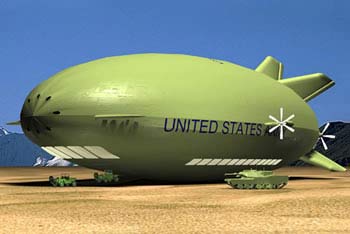
This particular gadget is, strickly speaking, not new. But it appeals to the alternate history lover in me. A world where the silly Nazis didn't build inflamable airships, and the skies were full of graceful and majestic dirigibles wafting passengers around the world in unparalleled comfort and elegance.

Instead, what we have is Jim Carrey in burn makeup saying, "Oh the humanity!" and this:

image

DARPA is shelling out millions of dollars to two companies for development of prototype military cargo airships.

The Walrus operational vehicle (OV) is envisioned to have the primary operational task of deploying composite loads of personnel and equipment (for example, the components of an Army Unit of Action) ready to fight within six hours after disembarking the aircraft. Walrus will operate without significant infrastructure and from unimproved landing sites, including rough ground having nominal five-foot-high obstacles. It is intended to carry a payload of more than 500 tons 12,000 nautical miles in less than seven days at a competitive cost. Additionally, Walrus will be capable of performing theater lift and supporting sea-basing and persistence missions to meet a range of multi-Service needs.

By way of comparison, the C-5 Galaxy can carry about a hundred tons 3000 miles without refueling. An airship would not be as fast as a cargo jet, but the ability to carry five times as much cargo and land it anywhere without need for airstrips is a really big plus. One of the chokepoints in our ability to project power globally is our logistics capability, and within that chokepoint is an additional chokepoint - the ability to rapidly move very heavy gear.

Airlift as we know today can move light equipment and troops nearly anywhere in the world in a matter of hours. However, heavier equipment can only be moved by the largest of planes or by ship or rail. Rail transport has a problem in that most of the world is under water, or not connected to the US rail system. Sealift is cheap and commodious, but rather slow. If you want to get stuff like an M1 tank to Eastern Outer Mongolia in a hurry, you are severely limited in options. You can transport them via C-5, but in doing so you sacrifice the ability of the C-5 to move massive amounts of other stuff, and you only get two tanks per flight. The opportunity cost of using the C-5 for this is thus very high. Ammunition, another important goody, also tends to be very heavy.

Air Logistics planners have a very difficult job. How do you get the best mix of lots of light stuff, and enough heavy stuff to the front quickly. Sealift is easier, but it can take thirty days or more to make one trip to a combat zone, and not all combat zones are on the coast. Like Afghanistan.

The walrus, or something like it, would be of incredible value. More than another new fighter, attack helicopter or destroyer. An efficient airship with a five hundred ton cargo capacity would increase our logistics throughput enormously, even if it is slower than a jet. And the flexibility granted by not needing an airstrip is almost beyond price. And once we have a few of these babies operational, other uses could surely be found for them as well. ASW, AWACS, in-flight refueling - in fact any function that requires long duration flight and cargo capacity but not speed. An airship might be slow, but no one expects an AWACS plane to be dodging missiles.

I say, lets get a couple hundred of these.

Posted by Buckethead Buckethead on   |   § 19