While reading the news about the recent Mars landers, I ran across this false color map of the Martian surface:
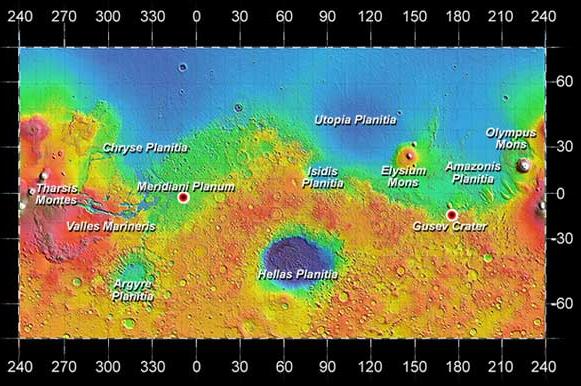
The colors are keyed to altitude, with blue representing the lowest parts of the Martian surface. This is a serendipitous choice, because we can get an idea what Mars might look like should we ever decide to terraform Mars. If we managed that incredible feat, the blue areas on the map above would roughly correspond to seas on a living Mars.
Terraforming is a rather bold concept - some argue that we couldn't begin to create a new ecosystem on Mars when we don't understand the one we have right here. Others argue that it would be wrong on general principles meddle with the environment as it exists now on Mars. Others, more pragmatically, argue that it's just too hard or it will cost too much, or any of the standard objections to doing anything new. I disagree with all of those objections.
The evidence is increasingly strong that there is water ice on Mars, most likely in great quantity - both in the polar ice caps and frozen in the soil. There is also frozen carbon dioxide in the polar caps, which is a useful source of materials we'd need in a terraforming program. Most of what we would need is already present on the Martian surface, but locked away where it does nothing to support conditions suitable for life. Scientists believe that liquid water once existed on Mars, and that the atmosphere was once far thicker. If we can alter the balance on Mars, we can (hopefully) tip it toward a warmer and wetter environment.
Currently, Mars temperatures are within shouting distance of conditions on Earth - just colder. But the atmosphere is very thin, and composed primarily of carbon dioxide; and the planet is very, very dry. We can engineer changes, but the most effective means will be those that start a virtuous circle of changes, and leverage natural processes on Mars to change the climate towards something that we could live in. So, we need to make it warmer, and wetter, and increase the thickness of the atmosphere. How do we go about it? There have been many proposals, and here are some:
- Cover the Martian ice caps with a thin coating of carbon dust. The black dust will absorb heat, and help to melt the ice caps. Once the ice begins to melt, water vapor and carbon dioxide act as greenhouse gases which will reinforce the melting.
- Construct very large orbital mirrors, made of very thin reflective mylar. Using these mirors, we can increase the amount of heat and light hitting the Martian surface. By aiming them at the poles (where the sun is teh weakest already) we can melt the caps with effects similar to those described above.
- Release large quantities of CFCs and other powerful greenhouse gases into the atmosphere to increase heat retention.
- Introduce genetically engineered algae and other microbes to begin releasing oxygen and other useful gases into the Martian air. These would also form the beginning of a Martian ecosystem.
- Lob a comet or ice chunk from the rings of Saturn onto Mars. Actually, you wouldn't want a big, dinosaur killer type impact. It would be more effective to have a continuous shower of ice rocks which would deposit their loads of water, oxygen, and other volatiles directly into the atmosphere without impacting the surface.
If a terraforming project ever does start, it would likely use a combination of some or even all of these methods. The key, at the start is to induce warming. Once we warm Mars, and starting with the polar ice caps, we can begin to get Mars working for us. As the polar ice caps melt, CO2 will sublime directly into the atmosphere, increasing the density. Denser air retains heat better, which will increase the effects of whatever means we are using to melt the caps. Water vapor released into the atmosphere will further push this cycle.
As mean temperatures rise, and pressure increases, we should begin to see the effects of warming all around Mars. Subsurface ice deposits and permafrost (if they exist, but it seems likely) near the equator will begin melting, adding to the effects started at the poles. Here, larger iceteroids might be used to hit concentrations of subsurface ice, and the impact will release water vapor into the air quicker than otherwise would be possible.
At the bottom of the Valles Marinaris, the immense canyon as wide as the continental United States, air pressure will rise fastest. Here we can begin to introduce the first of the microbes that will begin to change the thickening atmosphere from largely CO2 to one more closely resembling Earth's. By introducing bacteria similar to those that once lived on Earth a billion years ago, we can get oxygen into the air. These organisms excrete oxygen as a waste product. As oxygen levels rise, these bacteria will die - because too much oxygen is poisonous to them. They will then form the food for the next wave of colonists. Algae, nitrogen fixing bacteria, lichens, whatever will survive in the thin but increasingly homelike Martian atmosphere.
While the first organisms are being introduced and tested, more mechanical processes will continue. When the Martian air is thick enough and warm enough, and saturated with sufficient oxygen, we can begin introducing life that evolved for conditions at high altitudes, extreme cold and dryness. They will push the ecology further. As the basins fill with water, creating the first seas and oceans, we can stock them with life as well. The seas of Mars will quickly become the primary driving force for thickening the atmosphere, and conditions there suitable for earthly life sooner than the cold desert of the dry land.
One thing that is most promising about the introduction of life to Mars is that beyond a certain point, we don't need to be overly concerned about what we introduce. If we get an atmosphere even a quarter as thick as Earth's, with half the oxygen, we can start introducing Earthly life. Whatever thrives will thrive, and the ecosystem will begin to develop a rude equilibrium. As the air thickens, we introduce a wide variety of other species, and again let nature take its course. The only thing we need to be careful about is making sure we don't introduce mosquitos, horseflies or ticks.
The life that survives will contribute to the process. And the lessons we learn will guide us in the later stages of terraforming. It will be an immense laboratory for the environmental sciences, and those lessons could easily be applied here on earth. Eventually, there will come a day when conditions reach "shirt sleeve" levels - when the air is thick enough and warm enough that men can walk on the surface with nothing more than winter clothing and an oxygen mask. Later, we would reach a point where the air is equivalent to high altitude areas on Earth.
Then, we can build ski resorts with hot tub equipped condos on the slopes of Olympus Mons, the highest mountain in the Solar System.
Smarter people than I have looked at the ideas behind terraforming and believe it could work. Given the resources and the will, it could be done, especially as conditions on Mars are already so close to Earth's. Terraforming say, Venus, would be much more difficult. Thinking about moving comets and building hundreds of mile wide mirrors seems incredibly hard and at the very least hideously expensive. They would be, now. But if we move into space, we will develop the skills to do these things - we'll have to. If we construct solar sailing ships, we'll learn to create large lightweight mirrors. The Martian terraforming mirrors will just be larger versions. If we go to the asteroid belt, we will learn about moving rocks in space. Moving something in space is easier than moving something on Earth, because there is no gravity, no friction to slow it down. Even the largest rocks can be moved by a constant application of even a small amount of thrust. The more we live in space, the more we will learn to do things on a huge scale. Space is big - if Europeans think Americans are bad for thinking big, they will hate our descendants who live and work in space.
Soon enough, we will have the skills do do it. And the cost may not be all that much to a civilization that lives on the scale of a solar system. The biggest objection that the project will have will come from the environmentalists, who will insist that Mars be left as it is. If life is discovered on Mars, terraforming would certainly kill it. That would be a reason not to proceed. But if Mars is a dead planet, I see no reason why we shouldn't expand not just human life, but all earthly life to another home. For insurance against accidents like the dinosaur killer if for no other reason.
Instead of a dead, dry and cold world, we could have another Earth. Beautiful as Earth is, but different, with new wonders for us to experience. Dolphins and whales could swim in Martian seas; and who knows, perhaps we can make good on the Jurassic Park idea and bring back the dinosaurs, and give them a new home on Mars. Along with Mammoths, Mastodons and sabertooth tigers.
And hey, if that ends up looking a little like Edgar Rice Burrough's Barsoom, so much the better.



 on
| § 4
on
| § 4